
Upcoming events
The Wilderlab team will be at the following 2026/27 events to discuss all things eDNA, research, and biodiversity. We'd love to talk to you
Watch our video webinars
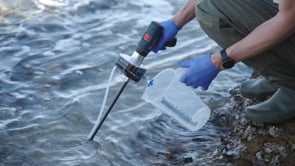
Instructional video for Wilderlab's SC600 Peristaltic Pump and eDNA Pump Kit instructional video
Instructional video for Wilderlab's SC600 Peristaltic Pump and eDNA Pump Kit instructional video
In this presentation, Dr Andy Hicks, Principal Ecologist at Stradegy Planning Ltd, describes New Zealand's journey towards operationalising eDNA for freshwater monitoring.
Environmental DNA (eDNA) has moved rapidly from a promising research tool to an increasingly mainstream approach for assessing freshwater ecosystems. However, one of the main challenges that remain is not the science itself, but translating that science into practical, repeatable and defensible monitoring programmes that can be used by consultants, councils and communities. In a manner that instils trust and confidence in everyone along the way.
In this presentation, Dr Andy Hicks, Principal Ecologist at Stradegy Planning Ltd, describes New Zealand's journey towards operationalising eDNA for freshwater monitoring. Drawing on experience from regional council monitoring programmes, central government investments, ecological consultancy projects, and national collaborations between scientists, practitioners and laboratories, Andy explores the technical, funding, governance and implementation challenges that are being overcome along the way.
The presentation covers the development of standardised field protocols, approaches to quality assurance and data interpretation, the integration of emerging eDNA indicators with traditional monitoring frameworks, and lessons learned from applying eDNA across a wide range of freshwater environments.
The result has been the establishment of a practical and consistent monitoring approach that are now supporting both ecological effects assessments and long-term State of the Environment monitoring programmes across New Zealand.
In this webinar, Dr. Ryan Kelly highlights ongoing quantitative work in both single-species and multi-species contexts and at a range of spatial scales, with particular emphasis on eDNA being used for practical management purposes.
Ecological and management questions often require quantitative estimates of abundance for species of interest. Answering that with environmental DNA (eDNA) means understanding the ways eDNA observations do, and do not, reflect underlying abundance, and being able to communicate those limits clearly.
In this webinar, Dr. Ryan Kelly highlights ongoing quantitative work in both single-species and multi-species contexts and at a range of spatial scales, with particular emphasis on eDNA being used for practical management purposes. As eDNA analyses become more common and more sophisticated, it is increasingly tractable to know more precisely what we’re measuring.
Ryan is a Professor at the University of Washington, where he directs the eDNA Collaborative and serves as Associate Director of the School of Marine and Environmental Affairs. He is also a Strategic Advisor to Wilderlab. Ryan holds a PhD in Evolution, Ecology, and Environmental Biology from Columbia University and a JD from the University of California, Berkeley.
In this webinar, Jacopo Orazi from Radice Soil Solutions explores how soil can be assessed as a living system, and why soil biodiversity can act as an early indicator of disturbance, recovery and ecosystem resilience.
When we assess the health of a forest, we often look at the diversity of plants, birds, insects and ecological interactions. When we assess the health of a river, we look at water quality, aquatic life and the presence or absence of key organisms. Yet when we assess soil, we still often rely heavily on a small number of chemical indicators such as nitrogen, phosphorus, potassium and organic matter.
In this webinar, Jacopo Orazi from Radice Soil Solutions explores how soil can be assessed as a living system, and why soil biodiversity can act as an early indicator of disturbance, recovery and ecosystem resilience. Through practical case studies across farmland, restoration areas and native forest reference ecosystems, Jacopo shows how tools such as eDNA, can help us better understand what is happening below ground.
The webinar also introduces Radice's new online interpretation dashboard (Radice SoilSignal), and how it translate soil eDNA results into practical management decisions, to support soil restoration and land management.
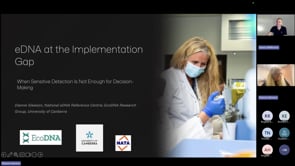
Professor Di Gleeson - Director of the National eDNA Reference Centre at the University of Canberra - explores the growing implementation gap between research capability and operational adoption.
Environmental DNA (eDNA) research has expanded rapidly, demonstrating extraordinary sensitivity and broad applications across biodiversity monitoring, biosecurity, and ecosystem assessment. Yet despite this scientific progress, uptake into routine regulatory and management practice remains limited. Many agencies and end users still lack confidence in the consistency, comparability and defensibility of eDNA data.
In this webinar, Professor Di Gleeson - Director of the National eDNA Reference Centre at the University of Canberra - explores the growing implementation gap between research capability and operational adoption. She will examine how issues such as inconsistent methodologies, variable QA/QC, limited standardisation, and uncertainty around interpretation are constraining trust and decision-making. The talk argues that the future success of eDNA depends not only on technical innovation, but on robust standards, validated workflows, proficiency testing and fit-for-purpose quality systems that enable eDNA results to be trusted in real-world management and regulatory contexts.
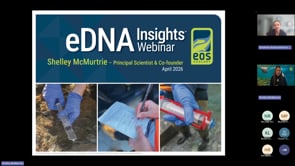
In this webinar, Shelley McMurtrie (Principal Scientist and Co-Founder, EOS Ecology) introduces eDNA Insights — a workflow designed to transform complex eDNA output files into clear, analysis-ready information.
In this webinar, Shelley McMurtrie (Principal Scientist and Co-Founder, EOS Ecology) introduces eDNA Insights — a workflow designed to transform complex eDNA output files into clear, analysis-ready information.
Shelley takes you behind the scenes of the eDNA Insights process, demonstrating how raw eDNA data is input, checked against key biodiversity databases, and translated into summary outputs that highlight the plants, algae, animals, and invertebrates detected within a sample. This workflow also identifies uncertain results and organises information so that meaningful ecological patterns can be more easily identified.
Shaun Wilkinson explains the development and science behind peristaltic pump sampling followed by the SC600 product launch, including pricing and information.