
Otago skink eDNA tunnels
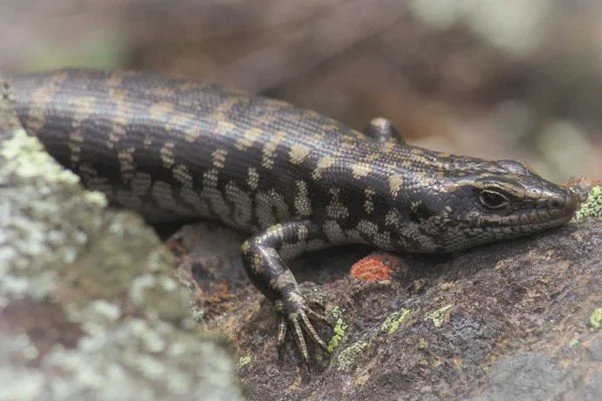
No longer a pipe dream: monitoring an endangered skink with passive eDNA
A simple baited pipe fitted with a fine mesh filter detected endangered Otago skinks 30 to 50% more often than traditional field surveys at the same site. The results are now published in the New Zealand Journal of Ecology.
Terrestrial species can be hard to monitor with eDNA. Waterways collect DNA from fish and other aquatic life, but land animals like skinks rarely turn up in water samples. The Otago skink (Oligosoma otagense) is also cryptic and sparse, living among rock outcrops in Central Otago, which makes it difficult to find by eye. Existing methods rely on physical capture, visual sightings or electronic devices that are prone to failure, and visual surveys depend heavily on the observer, the weather, and time in the field. With many of New Zealand's lizards threatened with extinction, there was a real need for a low-cost, non-invasive alternative.
To get skink DNA onto a filter, Tom Reeves and Samuel Purdie (Southern Lakes Sanctuary), Shaun Wilkinson (Wilderlab) and Nathan Whitmore (Reproducible) designed a passive eDNA tunnel. It is a pear-baited alkathene pipe lined with Dacron mesh. Skinks move through the pipe and leave traces of DNA on the mesh, which is then collected and analysed at Wilderlab.
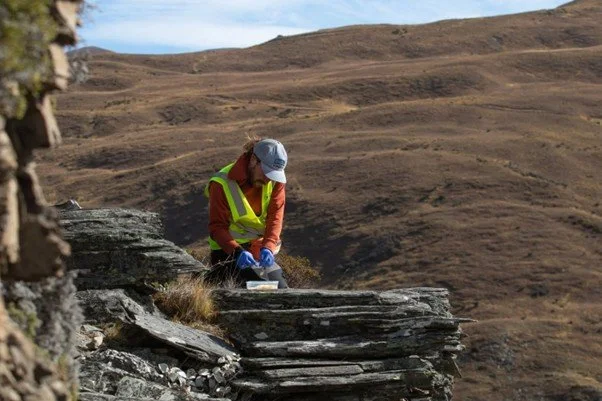
Tom Reeves from Southern Lakes Sanctuary Trust deploys a baited skink eDNA tunnel in the Southern Alps, Otago NZ.
Southern Lakes Sanctuary began developing the technique in 2022. The first trial, in autumn 2023 at the Mokomoko Dryland Sanctuary, suggested the pipes could detect Otago skinks and showed how long they needed to stay in place. A second trial at Mokomoko tested whether bait could boost detection rates. The team then ran a full-scale occupancy survey outside the managed sanctuary, in the Awa Nohoaka Conservation Area, and compared the results with historical survey data from the same area.
Alongside the higher detection rates, the eDNA data showed the population likely occupies less habitat now than it did in 2005 to 2007. The estimated range retraction is 38%. This fits with 50 animals being removed for a captive breeding population between 2009 and 2014, and with ongoing pressure from introduced predators.
The authors found eDNA tunnels also reduce observer bias, improve field team safety and make scheduling more predictable. Because one eDNA sample can detect many species at once, the method is likely to be most cost-effective when monitoring two or more hard-to-detect species together. That makes it a strong option for long-term monitoring of other cryptic lizards, especially those living around rock outcrops where their likely movement routes are easy to predict.
This work was supported by the Southern Lakes Sanctuary Trust, with funding from the Leslie Hutchins Conservation Foundation and the Otago Science Participatory Fund Platform through Curious Minds.
Image credits: Southern Lakes Sanctuary Trust