
UNESCO eDNA Expeditions
Mapping marine life at the world's most precious ocean sites, with help from citizen scientists
Wilderlab is the technology partner for eDNA Expeditions 2026-2026, an initiative powered by the Intergovernmental Oceanographic Commission (IOC) of UNESCO’s Ocean Biodiversity Information System, and funded by Minderoo Foundation. Wilderlab will process thousands of water samples collected by communities, students and scientists at 25 marine protected areas around the globe.
The marine protected areas participating in eDNA Expeditions 2026-2028 are among the most ecologically significant ocean habitats on Earth. Yet for many of them, we still have only a partial picture of what lives there, and little long-term data to show how that is changing.
Surveying these sites the traditional way takes specialist divers, boats and taxonomists, which is hard to sustain across dozens of locations. The eDNA Expeditions set out to change that by putting simple sampling kits in the hands of local communities, then using DNA sequencing to reveal the species present in the water. A single litre of seawater can hold genetic traces of a hundred species, from bacteria to whales, and data that once took years to gather can come back in weeks.
A first pilot phase proved the idea works. Around 250 citizen scientists sampled 21 World Heritage marine sites and identified more than 4,000 marine species from around 400 samples. The next step was to scale up and keep monitoring over time.
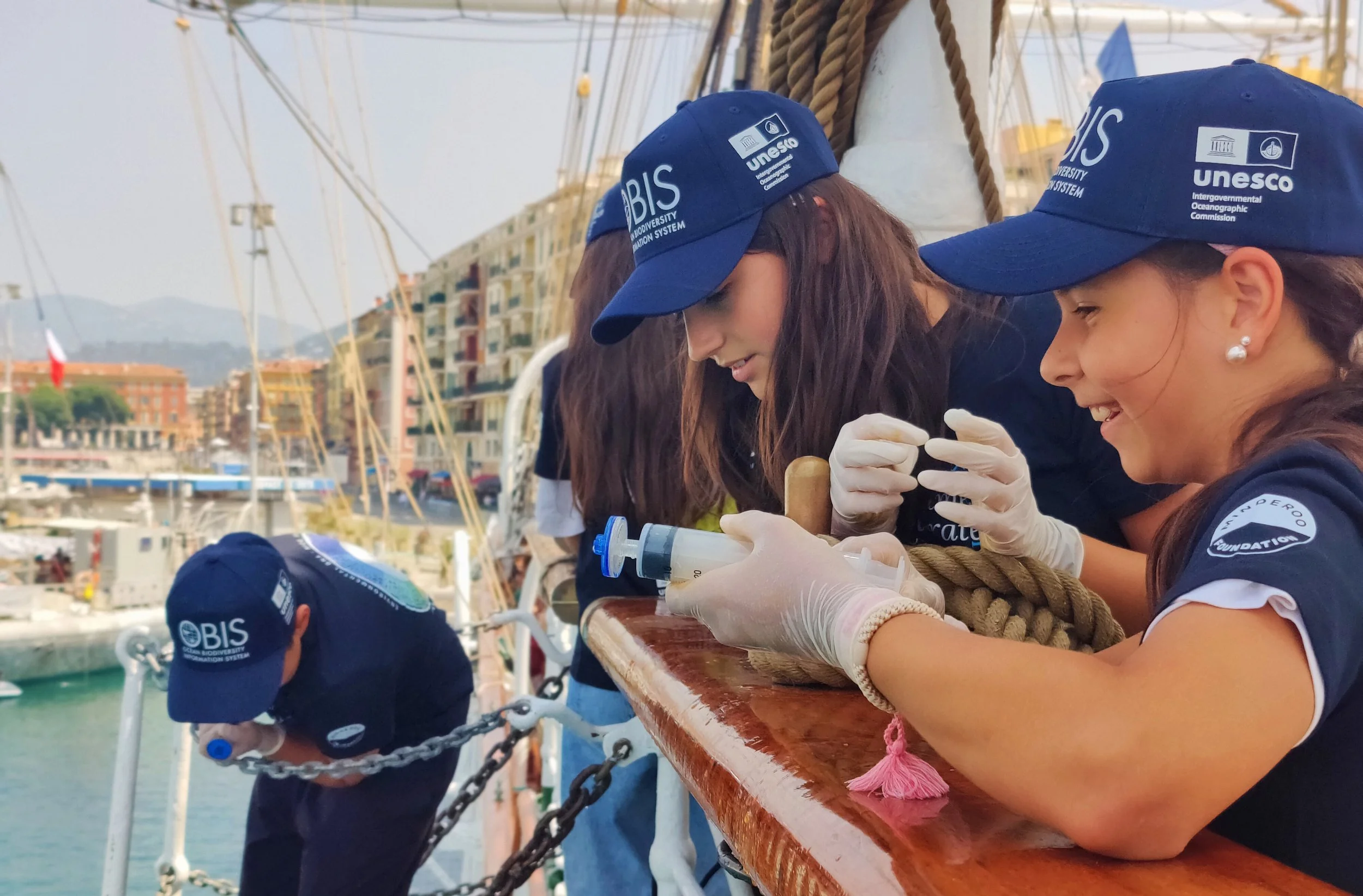
Image: UNESCO eDNA Expeditions Phase II kicks off aboard the Statsraad Lehmkuhl in the Port of Nice. Photo: Minderoo Foundation.
Thanks to an AU$3.5 million grant from Minderoo Foundation, eDNA Expeditions 2026-2028 aims to:
Establish long-term eDNA monitoring at 25 marine protected areas that serve as global reference sites
Support local monitoring needs and answer local questions to support decision making in resource and area management
Collect 3,000 eDNA samples from some of the world's most precious and least explored environments
Generate high-quality, accessible biodiversity data by establishing a network of molecular observatories, and building the full data workflow from analysis and quality control, to open data sharing and ecological insights.
Build capacity across participating sites in the application of eDNA metabarcoding
Mobilise citizen scientists, communities and young people worldwide
eDNA Expeditions 2026-2028 started on 12 June 2025 at the UN Ocean Conference (UNOC3) in Nice, France. Aboard the historic Norwegian tall ship Statsraad Lehmkuhl, sixth-grade students from the "Méditerranée" class at nearby Collège Ségurane collected the programme's first samples.
"Our key message is that anyone can take an eDNA sample and help to build a wave of biodiversity monitoring around the globe." - Professor Mike Bunce, Director of OceanOmics, Minderoo Foundation
As the technology partner, Wilderlab supplies the sampling kits and analyses the samples. Science teams use a peristaltic pump sampling kit, while other participants use our standard syringe sampling kits to collect seawater, push it through a sealed sterile filter to capture DNA, and log each sample. The filters then come back to Wilderlab, where we sequence and analyse every sample in our ISO 17025-accredited lab. After a thorough quality control process, the results are delivered directly to the participating sites to inform local action. The generated data is made available on OBIS, the largest global open-access platform for marine biodiversity.
Samples are now arriving from all over the globe, and every result adds to an open, growing record of ocean biodiversity. Because each site is sampled the same way year after year, the data will show not just what lives at these sites, but how it changes over time.
The programme also builds local skills. Communities and young people run their own sampling, learn how eDNA works, and see their results alongside scientists' data.
You can follow along on the Wildermap as new detections appear. Explore the Nice students' eDNA results, or read more about the launch on OBIS.